
In the world of specialty coffee, few origins spark curiosity and admiration like Yemeni coffee. It holds some of the highest prices on the market—and not by accident. While many may see only a high price tag, the story behind Yemeni beans is far more complex. The journey of Yemeni coffee is one of resilience, heritage, and craftsmanship.
Coffee Born in Extremes
Yemen’s geography is both a gift and a challenge. Coffee is cultivated in high-altitude areas that are remote, rocky, and often accessible only by foot. Unlike the flatlands of Brazil or Ethiopia, Yemeni farms are carved into terraces on steep slopes. This terrain limits mechanization, meaning almost everything is done by hand—from planting to harvesting.
Micro-Farming: Small Scale, Big Effort
Each farm in Yemen is tiny, often less than a hectare, with trees grown in tight clusters on family-owned plots. There's no room for industrial growth, so volume remains low. What you get instead is careful, detailed cultivation. Every tree receives close attention, resulting in high-quality cherries but limited quantities—which naturally drives up the value.
No Shortcuts in Farming Practices
Yemeni farmers don’t rely on synthetic inputs. Instead, they follow traditional, low-intervention agricultural methods that emphasize long-term soil health and sustainability. Fertilizers come from livestock; irrigation is rain-fed. The yields may be small, but the resulting cherries are dense, flavorful, and chemical-free—qualities highly sought after in the specialty market.
Manual Post-Harvest Work
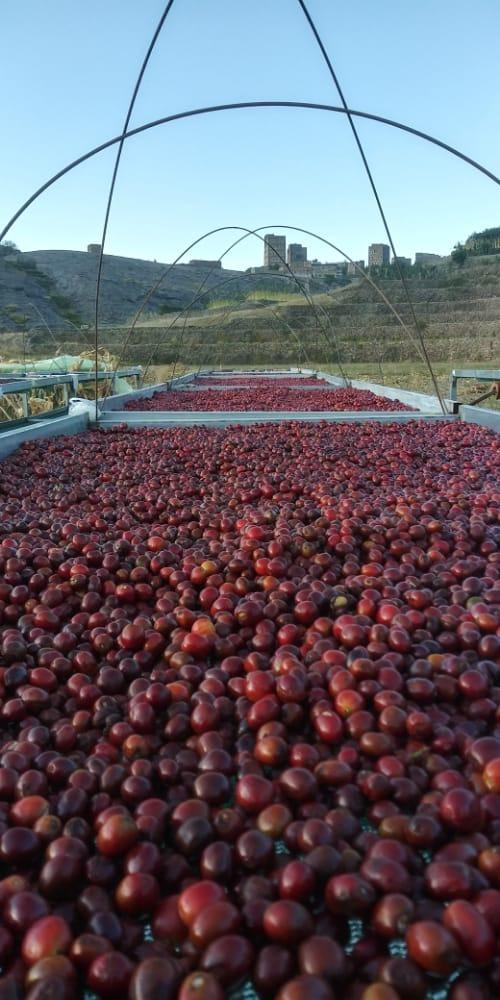
The journey doesn’t end at harvest. Drying is done naturally in the sun. Hulling and sorting may take weeks, and every step is performed with minimal machinery. This labor-intensive process adds to both the uniqueness and cost of the final product.
An Ancient Coffee Culture
Yemen’s relationship with coffee dates back over 500 years. The country was one of the first to commercialize coffee. These heirloom varieties—some of which exist only in Yemen—produce distinct flavor profiles that simply cannot be replicated anywhere else in the world.
Global Demand, Limited Output
In today’s market, the demand for rare and traceable coffees is stronger than ever. Yet Yemen produces only a fraction of what other coffee-growing nations produce. With only a few thousand tons reaching export markets each year, scarcity plays a big role in pricing.
Risk and Resilience
For Yemeni farmers, coffee isn’t just a crop—it’s a form of survival. Political instability, economic hardship, and a lack of infrastructure make coffee farming a high-risk venture. Despite these challenges, farmers continue to invest in their trees, their craft, and their communities. The price you pay helps support this perseverance and keeps one of the world’s oldest coffee cultures alive.
Conclusion
Yemeni coffee doesn’t aim to compete on volume—it wins through character. Its high price reflects its rarity, its heritage, and the remarkable effort it takes to bring it to your cup. When you drink Yemeni coffee, you’re not just enjoying a beverage; you’re tasting centuries of tradition, grown against the odds.